My husband woke me up early Sunday morning to show me an article about, of all things, clouds. An ordinary girl would be annoyed, being awoken in the wee hours by a man waving a blindingly bright phone in her face, insisting a bit too loudly, “Wake up! You have to read this!” Not me. Believe it or not I am perfectly content squinting though the darkness, trying to make sense of the colorful blurs before my mind has completely stopped dreaming (some of my best eureka moments happen in this state, after all). Of course, my husband usually figures out I can’t exactly see what he’s trying to show me and takes pity, reading the intended passage aloud, before I fall quickly back to sleep, happy–legitimately happy, not just because I get to go back to sleep, although that is nice too, but because the man just gets me.
This is actually a fairly common occurrence in our house, and it isn’t just a middle-of-the-night attempt by my husband to make me suffer his insomnia with him. He often calls during the day just to tell me about some amazing fact he happened across or hurries home after work to show me a picture of some place he thinks will be a great setting for a battle because he totally supports my need to include as much reality in my fantasy as there is fiction in my fantasy. I am grateful for all of the ideas my husband has come up with through the years, even the ideas I won’t ever use, and for the fact that my oftentimes begrudging nature as a writer never seems to get in the way of his enthusiasm, which I have to admit makes him my favorite person in the entire world. I love that he gets just as excited as I do about the prospect of inspiring wonder in people by showing them the magic that exists right here in the real world, no fiction required.
Sunday morning the wonder was fallstreak hole clouds, which apparently received some media attention after residents of Wonthaggi, Australia captured images of the rare occurrence last week. I’m not certain my husband realized that I actually have a fairly extensive file on atmospheric conditions already, which includes what I believed was every description of cloud known to man, until Sunday when my darling Official First Reader woke me up excitedly explaining that elves could in fact make these hole punch clouds when they fly–he had even thought of the fuzzy science to back it up (which made me laugh, in a good way, as I went back to sleep). I don’t know that I will ever write about a fallstreak hole in the way he envisioned them, however he will be happy to know that I have added it to the large list of anomalies witnessed in the Veils of Fate, and while I don’t know exactly what this veil will mean yet, I do know that it will be featured as part of a prophecy seen by Elijah.
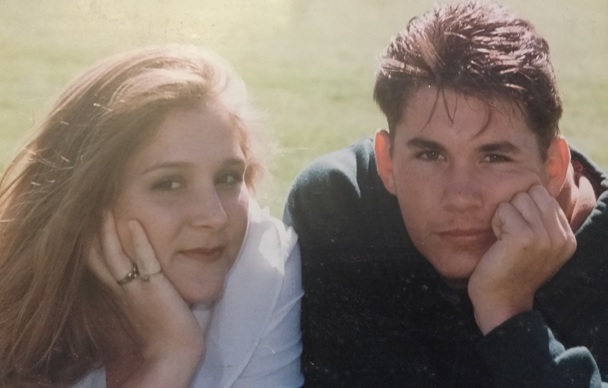
Me and my muse–weren’t we adorable? I don’t know how he’s managed it, but somehow this guy has put up with my nonsense for twenty-one years this week.
The truth is eureka moments, sudden sparks of genius, don’t happen often. Most people don’t have phone-wielding insomniac muses hanging around to be the light bulb that shines over their head on a regular basis, even in their sleep, so they have to work for inspiration. Not that I don’t work for inspiration as well–last week’s post on research hinted at just how much effort goes into finding the small hints of insight that fit within the puzzle I’m building by cutting out random shapes from reality and cobbling them together to make a picture that isn’t completely clear, even to me because my personal journey is about learning.
For the most part, great ideas are born out of this slow building of understanding. It is this slow building that allowed the image of a young Kazakh sayatshy girl to stick with me for months, until one day she became just a small facet of a character who makes her debut in book two of the series. This is how Stavanger, a city in Norway I’ve only visited through the miracle of the internet, became the place where years ago someone important to my characters died, though this man will only ever be mentioned as a ghost that walks through a conversation. Sometimes the slow building lasts for years, as in is the case with the history of fairies in New Zealand. In book two, I incorporate some of the traditional Maori tales into my own. And occasionally the fragile threads of a dozen other ideas come together as an actual spark of genius, to answer questions I’ve had for a very long time and been unable to find the answer just by searching, as is the case with Namcha Barwa, a mountain in Tibet also known as the Breast of Vajrayogini.
A lot of truly great stories, both real and imaginary, have inspired my work. I hope that one day people look back on the stories I write and find inspiration as well.
Before I get too far into this week’s post, I wanted to take the opportunity to thank Indie Reader for recognizing The Eleventh Age in their October 15, 2014 “Alike But Indie” column “If You Liked The Magician’s Land, You’ll Love…” It can be difficult being an author in a time when the industry is experiencing so much change. One doesn’t always know the right steps to take to get the work noticed, so it means even more when it comes unexpectedly, as this did. Thank you so much, Indie Reader! You seriously made my week!
Speaking of last week, I forgot to update the Character Tidbits page in all my excitement. To make up for my absentmindedness, this week I’ve posted two new pages–Phileas Foote and Ash (Aisling O’Toole), who is one of my favorite characters and happens to be the subject of this week’s Drawing Lesson, which I’m considering making a regular category, but we’ll see. So, without further adieu…
Never Draw a Changeling… Just Never.
In The Eleventh Age Elli’s best friend is the quick-witted, sharp-tongued, and beautiful Aisling O’Toole, who happens to be a halfling–half nymph and half goddess–which makes her a metamorph or shapeshifter. As I mentioned in a previous Drawing Lesson, Ash’s character sketch has given me enormous problems, so much so that I had to quit trying and come back to her with fresh eyes more than once. Since I finally managed to get her right, in honor of Ash’s metamorphic ways, I thought I would share her remarkable transformation.
When I’m drawing a character, I try to find people who look similar to the people I see in my head and work from there, changing them as I see fit. For the most part this is easy enough, and usually I can get a character down within the first three sketches. The girl I originally selected as the basis for Ash was gorgeous. I knew she wasn’t a perfect Ash when I selected her, no one was going to be, but I liked the shape of her features, especially her eyes, which were big but still pixyish and looked very much like the real Ash’s amber eyes. If I had known how difficult she would be, I would have chosen someone else from the start, though that probably wouldn’t have helped me much in the end. You’ll see why.
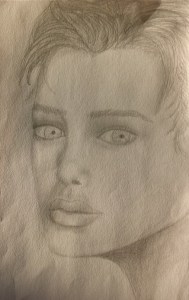
For the record, this was my third attempt with the original model with the perfect eyes. Even though the drawing is awful (by this point you can see my frustration coming out in the graphite), I am glad I didn’t throw it away like the previous two attempts because it’s nice looking back, to see just how much I’ve improved as an artist. (There’s a lesson in here about practicing, I’m sure, but who needs practical drawing lessons? If you’ve come to me for that, you’re in big trouble, but I digress.)
With every attempt at drawing this girl, I only seemed to get worse, and my younger daughter kept coming along, looking at my work, telling me her chin was too short or her nose was misaligned or her face didn’t fall in the right point on her head. She was a very patient critic, my Bird, even though I became more convinced that I was just a terrible artist with each sketch of not-Ash I drew. Bird is a teenager, so she might have just laughed at my struggles, rolled her eyes and gone about her business. Instead she kept repeating in her very best voice of reason, “It’s better than I could do, Mom. You’ll get it. Keep trying,” which I did, until about a month ago, when I decided I just couldn’t draw a person in profile and I turned to the great and powerful internet for help.
After watching some how-to videos on drawing, I came back to the original model recharged, drawing her several more times, altering hair and even the shape of her eyes, which was one of the things that I liked most about model 1 in the first place, but still I couldn’t get her right. I thought that if I just kept changing things, eventually she would look like the girl I saw in my head, and I wasn’t willing to give up… that is, until I was about half way through this drawing–the last drawing of model 1 ever made.
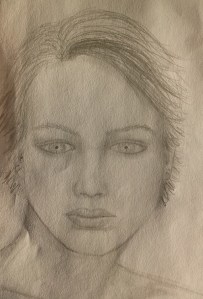
It is far better than the other drawing, as you can see, however even before I started her ridiculous hair (which I drew several ways before quitting, though the evidence didn’t come out in the picture), I had already figured out it wasn’t really that I couldn’t draw Ash, or even that some small thing about the model needed to be altered and if I could just find whatever it was and fix it, she would be the perfect Ash. The trouble was that the girl I was drawing repeatedly and requiring still more brief art lessons/therapy sessions with my fourteen year old for, was just not Ash, not at all, and I was too stubborn to recognize it. I don’t know who model 1 was, but she wasn’t who I thought she was.
This weeks-long endeavor at redrawing the same girl fifty different ways is how my hidden character inspiration board on Pinterest became full of dozens of potential Ash Wannabes, all of them beautiful, but most of them not at all Ash-like. Here are the other girls I drew in my search for the real Ash:
None of them were good enough, which is why it probably wouldn’t have done me any good to start with a different model, because I was just bound to go through this process, but at least I made some serious strides in my ability to draw a person the right way in one attempt, which is exactly how many times it took me to draw the fifth model, who turned out to be the one.
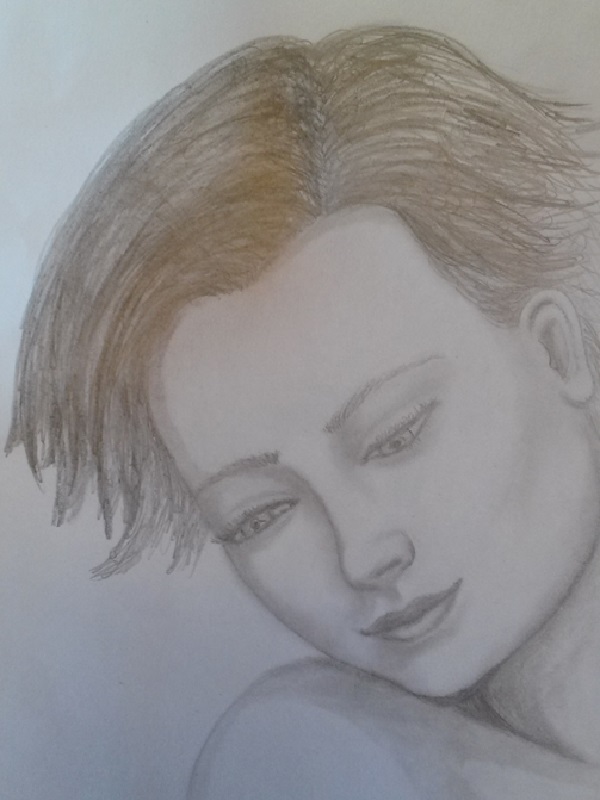
Ash.
Ash, the changeling
I’m not certain why I had such a difficult time finding her to begin with, in fact, when I started drawing model 5, I thought she would likely end up in the Not-Ash pile as well. But now that she is finished, with her coy eyes and her lips that hint of a thousand secrets and her wild hair that gives away just enough of who she really is at heart to satisfy that she does not take herself too seriously, I’ve decided that maybe the reason this has been such a difficult journey has something to do with the nature of Ash’s character as a shapeshifter.
Needless to say, if you are going to start drawing people, whether for your work or as a hobby, I highly recommend you steer clear of all changelings, because they have a nasty habit of changing on you when you least expect it. Beyond that, remember that just because a person might be a changeling doesn’t mean they want to be changed by you. I suppose you could say that I have learned not to keep sketching the same person, hoping somehow she would magically turn into someone she was not for my sake.
Yesterday I published Blackeney’s character page, which honestly gave me a bit more difficulty than any other character so far, though this really didn’t surprise me, because Black’s tale is darker, so he’s harder to summarize. The Eleventh Age is an epic fantasy, and all of my characters fit fantasy archetypes at the surface–after all what is a fantasy without its trusty tropes? Black is no different from any of the others in that respect, however when I first started writing several years ago, my original goal was simply to produce an action-packed, young adult fantasy that had a female hero, because I thought the world could use more stories about girls, who weren’t quite as transparent as their glass slippers, but as I began building my world, in which young Elli Foote, like many a hero before her, discovers her extraordinary purpose and embarks on her harrowing journey with her band of trusty tropes at her side, I developed a few ulterior motives. I wanted to write a story with a moral at the end. I wanted to write a story that crossed cultural boundaries. I wanted to write a story in which my characters spoke to real-world issues, suffering the sort of troubles ordinary people suffer, like loss, abandonment, poverty, hunger, abuse–all of these are things Black has experienced firsthand, just to name a few, which is what made writing his summary so difficult. My trouble was in remaining true to his character without giving too much away, which I think I’ve managed.
I’ve alluded to this desire to keep my characters real before. Not only do all of them have to have flaws and hidden agendas, weaknesses and passions, but all of them must have perfectly rational reasons for their otherwise odd behaviors. Black, for instance, is a warrior who does not fight, and his reasons are rational and uniquely his own. The thing is, Black knows as well a I do that what is rational is not always logical, and our rationalizations can sometimes (read: almost always) be built upon false beliefs. We humans are actually quite adept at dealing in false beliefs, which brings me to the topic of the day:
Monkeys, Babies, and the Moral of the Story
If you are reading this, chances are 1. you are human and 2. you possess fairly well-developed theory of mind, which is, very basically, the ability to understand that you have a mind, which holds knowledge, beliefs, and intentions unique to you, and that others have minds of their own, in which they hold separate knowledge, beliefs and intentions that are different from yours and everyone else, for that matter. This probably seems fairly straightforward, especially since you’ve possessed the beginnings of this theory of mind since you were as young as seven months old, however even though it seems obvious, this theory can only ever be a theory because there is no way for me to prove that you have a mind or for you to prove that I have one, because we are each only capable of experiencing the world from our singular perspectives, and anything else is, well, just theory. What this theory of mind allows you to do is to make assumptions, based on your own understandings, in order to predict or explain other people’s actions, and it comes in quite handy in just about every interaction we have with one another (and anything else we perceive as having a mind, it turns out).
Scientists have been working for decades to determine if humans are the only animals that possess theory of mind, to determine if this is in fact what distinguishes us as humans, which is a rather difficult task, because animals and humans don’t speak the same language, though we can understand certain animal behaviors as similar to our own. There is plenty of documented evidence supporting the idea that animals have emotions. We know elephants and gorillas cry over the loss of family and friends, even across species. We know dogs will visit the graves of deceased companions. But while we’re perfectly aware that other animals have minds, after all our theory of mind allows us to assume this by their behaviors, whether or not those animals possess a theory of mind and are aware that we have minds as well is open for debate.
If you’ve ever played fetch with a dog, you know that animals are capable of viewing your behavior and predicting what will happen next. We had a Belgian Malinois years ago that I loved to try and fool when playing fetch. I could see that she would watch my eyes and the angle of my arm and take off milliseconds before the ball ever left my hand, and very rarely did I ever fool her. The dogs we have now are not quite so intuitive–one of them just looks at the ball, dimly, like he’s still not certain what it is, while the other will go after the ball and keep running past it forever, but now I’ve gotten sidetracked. It is clear from my own experience that dogs are definitely aware of what people are looking at and capable of making predictions about their actions. For a while, some researchers had the idea that this sort of awareness of visual access might be evidence of full-blown theory of mind in other animals.
O’livia, the Belgian, even displayed some cross-species compassion once, a few years before she died. Though she never had puppies of her own, she attempted to nurse an opossum that had been abandoned and wandered into our yard, weak and blind and squealing for its momma.
Livy and her possum pup, safe between her legs
Initially I believed that my wonderful, bright dog had chosen to display the tenderness of motherhood, and trust me when I say that Livy was anything but tender under normal circumstances. It definitely seemed to me that she understood the baby opossum was lost and alone and hungry, and that she knew just what to do and actually wanted to help. Then I found the first baby opossum to make it into the yard, very much dead, and the second, dead as well, and I began to wonder if perhaps this third opossum, whom she was being kind to, nursing even though she had no milk, was really lost and alone and hungry, and having found a warm, furry body, it had climbed up and attached to Livy by mistake, while dear ol’ Livy was busy murdering its siblings (much more Livy-like behavior). I began to suspect that when the opossum attached and began to suckle, it triggered her mothering instinct, probably through a release of hormones, and that overrode her hyperactive prey drive. I will never know if Liv actually possessed a theory of mind capable of commiseration with and showing compassion towards a baby opossum, but I do know from my experience that I am just great at anthropomorphizing all manner of animals and creating false beliefs within my own little theory of mind. I’m officially human. Yay!
Recently, developmental psychologists and comparative cognition researchers have managed to conduct several false-belief task tests on human babies and various primates. This sort of testing was necessary because one of the most important steps in development of theory of mind is establishing the ability to distinguish what another person can or can’t know based on their observations. The comparative cognition researchers were beginning to suspect that all primates had a solid theory of mind based on other tests that definitively showed primates (and other animals) have a visual awareness that extends to others, like with my dog, Liv. For instance, a monkey is more likely to steal a piece of food it knows has not been seen by its owner, and they even retain this knowledge in the future, but without non-verbal tests for false-belief tasks, they couldn’t draw a firm corollary between visual-behavioral awareness and behavioral-mental awareness. (You can and should read about some of these false-belief tests and their results here, I just wanted to give a basic idea moving forward.) In each of the false-belief tests, what is being examined is whether or not the subject (baby or monkey) understands what a second subject can know based on its experience. For instance, the baby or monkey watches the second subject place an object in a specific spot, and while the second subject isn’t paying attention, the object moves somewhere else. Will the baby or monkey know that the second subject must believe that the object is in its original spot (i.e. does the baby or monkey have an understanding of what the second subject knows based on its world view)? It turns out that 15 month old human babies consistently exhibit that they understand and are not surprised by true-belief based actions committed by the second subject (when the subject returns to where the baby last saw the second subject place the object), and they consistently exhibit that they understand and are surprised by false-belief based actions committed by the second subject (when the subject returns to look where the object actually is, where they could not have seen the object go). Human babies, surprise, surprise, have a developed theory of mind. Much to the dismay of the comparative cognition researchers, monkeys don’t care, either way. Once visual access is lost, the monkeys no longer expect the second subject to look in either spot, whether during the true-belief test or the false-belief test, because as far as a monkey’s concerned, the subject can’t know where the object is. This does not necessarily mean that monkeys don’t have a theory of mind, by the way, it may just mean that their theory of mind relies on continuous observation, because they are continually observant, and their theory of mind is based on being a monkey, which you have to admit makes a little more sense than their theory of mind being the same as us humans. If their theory of mind were just like ours, they would probably be out there conducting tests on pigmy goats to determine whether or not pigmy goats too think like apes and humans, but they aren’t.
I have no vested interest in whether or not this proves that humans are massively unique, so you might be asking yourself why is this important to me? Because other animals dance and sing during mating season, and we people find it fascinating and devote whole studies to it, and frankly, it’s that sort of stuff that I find fascinating. Humans dance and sing all the time, just for fun, and we’ve got people who study that too. Unless we’re depressed or otherwise inhibited, we seem to always be spit-polishing our feathers, because we are very much concerned with what others think about us–other people and other animals as well, it seems. We lie for attention and affection. We cheat on tests in order to give ourselves a false sense of security and to instill in others a false belief of our abilities. We don’t just watch life, observing the real, we all play mentalists, examining other people for signs they are bored, hungry, angry, tired, lying, and a plethora of other interesting little things we believe they might feel or do at any given moment, based on that theory of mind we’re so keen at using, and we habitually make up stories to answer that profoundest of questions: why?
We read whole books about how other people go through their lives, and we invest ourselves deeply in their worlds, purely for entertainment purposes. We even write whole books for the entertainment of others, which is stranger still than reading, because it requires that we not only consider that other people have minds, but that we have an understanding of how to manipulate and influence those minds, by creating still more minds, all worrying very humanly over the contents of still other minds, just to elicit specific thoughts and emotions, not in ourselves, but so that the moral of the story is understood by someone else in the end. The depth of our theory of mind means that we don’t just cry when we lose our own loved-ones and friends, we cry when people we know lose loved-ones and friends, we cry when we hear about people we don’t know losing loved-ones and friends, we cry when elephants cry because they have lost loved-ones and friends, we even cry when we read about fictional creatures from other universes crying over elephants crying over losing loved-ones and friends. Okay, I made that up. But we do read about conferences where other people talk about studies still others have conducted to determine if other primates understand false belief, and we ask ourselves questions like, “Even if they did understand false belief, would they be capable of understanding it to the depths that we do?” which gives rise to still more questions and potential things to study, which leads me to believe that perhaps the ability to ponder and theorize and postulate and query even though we have a fully developed theory of mind that is capable of understanding not just that some other person or animal can only know what he has experienced, but that sometimes people will surprise us, and we enjoy being amazed like that, might just be what makes us human.
Last night we watched The Pirate Movie, a 1982 adaptation of Gilbert and Sullivan’s Pirates of Penzance, which (Spoiler Alert!) ends with Mabel demanding and receiving her happy ending, both in her dream and when she wakes up washed up on the beach to her fantasy Frederic-without-a-K kissing her, for no apparent reason. Cue Happily Ever After Song and Dance:
Oh, silly Mabel, also without a K.
Anyway, this got me thinking about how liberally the sappy ending is applied for entertainment purposes, even in those works that aren’t intended to be farcical, and wondering why the general public prefers stories that leave a saccharine numbness on the brain to those that tell the truth in all her glorious despair, forcing us to accept life as difficult as it is, and acknowledge that all heroes die, most lovers grow bored and tired and some turn into miserable drunks, the money runs out far too quickly after a windfall leaving only destitution, the guy who survives the shark attack inevitably gets hit by a bus on his way home from the hospital… You get the picture.
I’m hardly the first person to question why we prefer our candy-coatings and rosy spectacles, and Google turns up an expert for just about every explanation, so I’ll spare you my musings where that’s concerned, except to say that the geek in me did find fascinating the idea that commiseration with fictional characters may cause a similar release of neurochemicals in the audience, as if when watching a film or reading a book, we are actually experiencing the lives of our favorite protagonists and antagonists as people we know and have legitimate feelings for. Oh, and I would be remiss not to mention it is a well-known, scientifically proven fact that giddy pirate song and dance numbers assure the survival of the species, ranking right up there with water, food and shelter as necessary to our very existence, but I’m no expert, so don’t quote me. (Okay, so it’s not a fact, but some of those experts should definitely do a study.)
While I, too, enjoy prancing pirates on occasion, I won’t deny that I’m truly a cynic at heart, one who enjoys harsher tales that force us to examine ourselves. When I watch stories like The Pirate Movie, I can’t help but see the catastrophe beyond the Happily Ever After, which to me is really just another happy beginning right before the next tragedy strikes and must be overcome. Silly Mabel, also without a K, will surely discover, soon after the credits roll, that her darling Frederic-without-a-K sees she is one who falls in love far too quickly, that she is a girl who will give him whatever he wants in the interest of continuing in this thing she believes is love, however she will not see it for what it is until Frederic has thoroughly taken advantage of her, leaving her broken and used up, probably singing on a beach somewhere, desperate for her next romance, because that is the way life works. I’m certain I’m not the only one who feels this way, I mean, look how Frozen ended. And even my sixteen year old daughter (who only a few hours before watching the movie read to me an open letter from another teenager to adults who read articles about teenagers, basically requesting that they stop treating teens like some strange beings to be stereotyped and categorized, quantified and explained away) couldn’t help pointing out that Mabel and Frederic’s relationship was “just like every relationship” at her high school, and we all know that the vast majority of those end in tears and bloodshed, usually not too long after the young lovers have professed their eternally dripping, syrupy-sweet, twoo wub to one another and refused for an hour and a half to be the first to hang up the phone.
As an author and a cynic, I’ve set out to tell hard truths in my writing. Though the story is set in present day and wrapped up in the real world, which will become more apparent in future works, The Eleventh Age is largely mythopoeic, and as such there is always the temptation (and plenty of opportunity) to take the easy way out, to fall back to some deus ex machina, or miracle event, to save my favorite characters from their fate, or resort to unrealistic devices to explain away inconsistencies, simply because the world is magical, like Mabel simply deciding that it was her dream, so she could have her happy ending, and Viola! Happy Ending. But in The Eleventh Age, Fate itself is a living, breathing character within the tale, a character very much at odds with our heroine at times, and let me tell you, Fate will not stand for too much divine intervention from the lowly writer, not even if it involves dancing pirates. Meanwhile I’m fairly certain the cynic in me would baby-vomit if I cheated and rescued someone I’ve known must die from the very beginning or had someone unreasonably fall in love just to play to a chemical reaction my audience expects to receive. I get great pleasure from forcing myself to think logically from so many perspectives at once, keeping in mind what all the major players and most of the minor players are doing and all of the whys and hows going on in the background, while Elli walks on the surface of the story and we see in the reading only what she sees, and the things that unfold are only seen as she unfolds them–oftentimes mistakenly and clumsily, because the fact of the matter is she is just a teenage girl. To me, writing is an extraordinary puzzle of human interactions, every character should be deep, and if they aren’t deep from the beginning, then it should only be because their depth has yet to be uncovered. Of course, I’m not going to pretend that I have some superior moral incite that justifies my work, I don’t, or that I am the most exceptional author, I’m not, but I do like for stories to be realistic, even my fantasies. And I love a large dose of bitter to cut through the sweet.
Needless to say, this means happily ever after might always be just happy enough for the time being, where Elli Foote’s concerned, but the poor girl can’t help it that her author’s jaded and a little cruel at heart.
Hi! I’m Luthien Kennedy; Lu for short and Lulu to my siblings, which I guess that would be for long-short. I’m the author of The Eleventh Age, which is what this blog is all about.
I’ve been very busy lately, when I’m not writing book two of the series, curating content and building my web presence, which is pretty scary for me, because I’m officially NOT John Green or even his brother–I’m a total introvert. You will never find a video of me explaining all of history like some mad genius with entirely too much time on his hands, and if you happen to like my work enough to make me famous, I will probably take to wearing fancy silk masks in public, à la Michael Jackson, or better yet the the long hijab-like veil the diva Plavalaguna wore in The Fifth Element (one of my top ten favorite movies, by the way).
My plan for this site, aside from blogging about what I’m doing (or in the case of writer’s block, what I’m not doing), is to provide a place for readers to find extra information about my work from character sketches to back-stories, scene mockups, links to further information, and the like. I intend to update the blog at least once a week and to regularly post new content, so visit often, like me on Facebook, and make sure to follow me while I get REALLY uncomfortable here in black and white, all for your entertainment!
To start, I thought I’d tell you what I’m currently reading. For pleasure I like to read fantasy and some sci-fi, but I tend to find myself soaking in a wide range of subjects for research (because I’m a little strange and love to learn). Right now I’m reading The Power of Myth, which is a book based on the documentary series Joseph Campbell and the Power of Myth with Bill Moyers. For more information see this link. But absolutely do not go out and buy this book. If you need something to read, you want to read The Eleventh Age, by yours truly.





 The Eleventh Age