Now that I’ve gotten that bold red header out of my system, let me say I’m not going to get in the habit of doing film reviews (this is not a review, by the way), but it is very seldom that a movie truly catches hold of me, slams me against the floor of my soul, strangles me with the tethers of own fear of inadequacy, and then makes me want to stand up and cheer for it, like it’s done me a favor, so bear with me for a moment while I just add to the endless list of accolades this film has already received: Whiplashis absolutely spectacular, Miles Teller and J.K. Simmons are phenomenal, and really, you must watch!
Okay, I’m done raving.
Since its release in October, it has been up for debate whether or not Whiplash sends the right message to aspiring artists, or if it crosses a moral line, especially where the pedagogy is concerned, as J.K. Simmons attempts to torment Miles Teller until he is one of the greatest drummers who ever lived. We know every artist suffers for his art, because in order to create masterful works, one must first become a master, and that takes time, patience, practice, dedication, a willingness to debase and humiliate oneself on a daily basis, admitting even the tiniest faults as many times as is necessary to perfect both the artist and the art, and, of course most imperative, one must have a massive will to survive, because in order to be great, one must first be broken… repeatedly. Given the volume of clichés surrounding the tortured and struggling artist, it would seem on the surface, if you haven’t bled for it, your work just can’t be good, or maybe it is good, but just good, and the work will never be anything beyond that because the suffering isn’t there. There are plenty of good works out there. As a matter of fact, the abundance of good in the world can be so deceptive, some would claim we’ve forgotten what great really should be.
Though I’m certain a slew of people would argue with me, in my opinion the best line in Whiplash is when Fletcher, the abusive professor, says to Andrew, his impressionable student, “There are no two words in the English language more harmful than good job.’ It’s true. To those who could be great, but don’t know it yet, those two words build a barrier to achieving excellence, as the average praise smothers the drive to be more. To those who would be great, and are struggling, the words are a poison. They find themselves whispering quietly to themselves, “Just good?” and if they lack survival skills, they don’t make it past being repeatedly broken by those two little words. That’s why there are so few greats. It takes so much more than talent to be great. It takes fortitude. Not many people have that.
As a writer, I completely related to Andrew Niemann’s brutal affair with his drum kit. Most days I’m content with being the drummer, pounding away, seeking perfection, knowing I’m not good enough, not yet, and I may not ever be, but I will continue on until the day I die. On occasion, I find myself playing the part of those drums, being beaten by bloody hands I can hardly recognize as my own.
Is it wrong to admit that I don’t want what I create to be good? I want it to be great, so I’ll continue struggling.
Our oldest daughter, presently sixteen, has decided she’s bored with high school and is ready to graduate this May, a year early, which is how she and I found ourselves traveling an hour out of our way this past Friday, to have her Senior yearbook pictures taken, long before I was emotionally ready, though I’m afraid I can’t say the same thing about her. She’s always been a fast girl. No, I don’t mean it that way. Lilia is the sort of girl who, at the ripe old age of three, got frustrated with a cartoon she was watching because the bad guy didn’t consider that if he destroyed the world, as he planned, he’d be destroying himself too, so she decided to help me cook dinner instead. Fast. Sometimes I wish I could slow her down, remind her to take her time, that it’s all right to be a little ridiculous and to enjoy her youth, which is funny because she often says the same thing about her little sister, who is two years younger than her and, in her opinion, much more serious, though really they are just serious in different ways. Then I get glimpses of days like Friday, and I can breathe a small sigh of relief because my fast daughter’s in love with a drummer she’s never even met.
As we climbed into the car Friday morning, and she proceeded to jack in her phone, simultaneously grinning boldly and looking flustered, Lilia informed me that she had a dirty little secret she needed to share, so I should just be prepared to spend the rest of the day listening to only one band–5 Seconds of Summer, the Australian boy band that has captured her heart, even though she knows she’s supposed to be above that sort of thing. “I don’t feel very guilty about it, because they aren’t really a boy band anyway, they’re a garage band,” she said rather emphatically, perhaps expecting me to judge her because their music is mainstream (what can I say? My kids know I’m a music nazi, though I’ve tried to loosen up some over the years and will even listen to their Pandora stations on road trips, if only to avoid the same ten Top 40 songs that are always on the radio). “They all play instruments,” she continued, “and they write their own music. They’re real musicians, Mom, and here! Just look at them!” she swooned, shoving her phone in front of my face while I tried to keep the car on the road. “Sorry. I’ll wait until we get to the gas station.” …Fast.
Let’s face it, Ashton Irwin is not going to show up at our little town and sweep my much-too-young-(and-probably-too-fast)-for-him daughter off her feet anytime soon, so I gratefully listened to Voodoo Doll at least four times anyway, along with every other song 5SOS ever played.
We laughed together about how she could, “totally marry a rock star, especially a drummer!” even though she has no idea how to meet a drummer, let alone how to date one. Being the sort of fast girl she is (and her mother’s daughter), she Googled, “how to date a rock star,” and right there at the top of the results was Mat Devine’s recent article in Galore, “5 Ways to Date a Rock Star“. So she read aloud, and we laughed some more, because there is something refreshing about a guy who admits right off the bat, “I’m pretty *expletive*… [but] Any girl that knows I’m in a band, and still kinda likes me… I’m like… RED FLAG!” (For those girls still determined to let their red flags fly, he went on to provide three and a half mostly-sensible pointers, which actually apply to dating any guy, not just rock stars. For the record, #4 only gets half credit, because there are some things on that list even fast-in-the-traditional-sense girls should never do, however where the line gets drawn is at #5, because unless you are at the show, the rock star you are dating should definitely want to have a proper shower before he sees you, otherwise he’s not worth your time. Even a Red Flag girl’s gotta have standards, Mat.) It was quite fun being on the inside of one of my daughter’s rare full-on teenager moments, but in the end my fast girl returned to her senses, deciding that perhaps it wasn’t the rock star she wanted to date, so much as it was the music.
I’m with her on that.
I mentioned that before I went off on a days-long tangent exploring other dimensions last week, I had every intention of posting about the music that has inspired my writing. Instead of writing about it, I think I should just let you fall in love the old fashioned way. So, here are three of the bands, who inspired The Eleventh Age in various ways, playing songs in the order of how rock star relationships usually turn out:
Now and then the distractions I suffer as a writer are of cosmic proportion, the sort of distractions that send me off on wild tangents that I am physically forced to take, otherwise my brain will crack for want of exploration, and I get completely lost in them. The trouble is, in some other universe I’m actually a theoretical physicist.
And that’s just the little bits and bobs I scribbled down as I took this weekend’s adventure that spilled over into all of Monday and now Tuesday, as I write this post. To think, I was actually going to post about the music that inspires my writing. Ha! I’ll just save that for another time.
All of this began when a fellow on Quora asked the question: “How can I understand the 5th dimension? Problems related to N-dimensional spaces are seen in Mathematics. But I can’t visualize how a 5th dimension would look? What exactly is it?”
Boy, is that a deep and never-ending rabbit hole.
Do you want an answer? I’m afraid you aren’t going to like it.
Basically, the answer, theoretically, comes down to something like this: A three dimensional cube is made up of two dimensional squares by doubling the points, and a two dimensional square is made up of one dimensional lines by doubling points, so it stands to reason that a four dimensional tesseract would be made up of three dimensional cubes by doubling the points, and by doubling the points again, we can make a five dimensional object (or pentaract) that is made up of tesseracts, made up of cubes, made up of squares, made up of lines, made up of points. Or something like that, but then it could be argued that three dimensional rules couldn’t be applied to a three dimensional object to make a four dimensional object in the first place, because they would require four dimensional rules, so a fifth dimension would definitely require fifth dimensional rules, and that in our third spatial dimension, the first spatial dimension only looks the way it looks, because we see it with three dimensional eyes, etc., but you see that spatially, there is (theoretically) no limit to the number of spatial dimensions possible. As a rule though, you must know that the 5th spatial dimension would actually be six dimensions–five spatial and one time (at least), otherwise there would be no seeing it for anyone, because perception of any kind requires time… Unless he was talking about what the fourth spatial dimension looks like, which is actually 5 dimensions, in which case, he might just watch the film Interstellar and have his mind wrapped around on itself rather than ask Quora what it looks like (and then instead he could ask why it is presumed that time would be folded in a 4 spatial five dimensional construct, so that a girl who thinks she is witnessing her mother’s ghost is actually witnessing her father interacting with his own past from the future in order to save the world). Unfortunately, we live in a three spatial dimension world, so we can’t know what a five dimensional object actually looks like (even in the movies), all we can do is make shadows on a two dimensional plane and rotate the shadow object in three dimensions, and pretend what we’re seeing is a reasonable representation. (Which begs the question, what does rotation look like in the 5th dimension anyway–is rotation even possible,or is spin only a three spatial dimension thing?)
I’ve seen all sorts of crazy on this little journey of mine. I would love to explain to you all of the ideas spawned by this particular rabbit hole, to explain why, in my humble opinion, time must be the first dimension or how I think I actually diagrammed the folds of time in a tesseract a few years ago without even realizing it, because I have been down this rabbit hole many times before, but I’ve really got to stop now. It’s time to declare this rabbit hole officially closed for business until some future Saturday, when I don’t have real work to do.
A fellow by the name of Joseph Campbell once (or twice) aptly described Myth as “other people’s religion”. Okay, so, he wasn’t just some fellow; he was fairly hyper-intelligent, massively well-versed in the areas of mythology, religion, psychology and philosophy, and has influenced many people with his works, including you, to a degree, if you’ve ever seen Star Wars or read Dan Brown. If you need definitive proof that you’re not doing enough with your precious few years here on this earth, just go read up on him, and once you’re through feeling totally inadequate and have been sufficiently inspired to do something greater with your life, perhaps you will set out on your own hero’s journey, to “follow your bliss,” as he would say. But before you do that, since you’re here anyway, you should go ahead and finish reading this post, which is not about Joseph Campbell, though that bit about myth being other people’s religion is important, so I’ll come back to it in a moment.
In the few months this site has been up and running, I have posted character pages for several of the main characters introduced in book one of The Eleventh Age, but so far I’ve only touched on many of the good guys, the heroes of the Eleventh Age myth, who are just embarking on their proverbial journey, which Elli Foote
Elli Foote, the hero of The Eleventh Age
believes is to find the Stones of Peace (or power, depending on who you ask), to protect them from Roviello Tofal, the ruler of the wizards, who happens to have survived the past ten thousand or so years solely for the purpose of destroying her, in order that he should finally become ruler of all of humankind (as her noble retinue has explained is her destiny, by way of a little story she comes to call The First Fairytale, which is the prologue in book one, if you’re interested). While this may sound a bit far-fetched, as it does to Elli, I can imagine it would be a bit difficult to stand in the face of a sea of true believers, who have all sorts of completed prophecies as compelling evidence of your greatness, and say to them you simply aren’t the messiah they’re looking for, though Elli does try, and then that silly ten thousand year old wizard, Tofal, decides to send his army, including the treacherous blood wraiths, to destroy the only home she has ever known, and it turns out there is nothing like having your home ripped apart by the followers of a ten thousand year old villain hell-bent on killing you to inspire a little off-the-beaten-path adventure in the middle of the night, as many a hero before Elli Foote has discovered the hard way. I have purposefully refrained from writing much about Tofal thus far, so as to avoid spoiling the pure evilness that I believe you should get to know in the same fashion as Elli–slowly, one death at a time.
However, I will say that quite a bit of study of the nature of evil has gone into creating Tofal’s character, which has been a cumbersome task at times. One only need to read a short way into this entry on The Concept of Evil (Stanford Encyclopedia of Philosophy) to understand that evil is a bit hard to pin down. In fact, we all have our own distinct ideas of what evil actually is, believe it or not. For instance, some people have a strictly religious sense of the term, and think about evil as being perpetuated by some supernatural force outside of oneself, while others have a totally secular sense of the term, and while they may or may not believe in a divine power, they do believe that there are some human acts that are so fundamentally abhorrent that only the term evil can apply, though that evil is seen as strictly of this world and man’s making. At the opposite end of the spectrum are those who believe there is no such thing as evil in any sense of the term, either because it requires a supernatural entity in order to exist or because defining an act as evil has a tendency to beget more evil, and doing so is therefore incredibly dangerous, so such acts that would otherwise be deemed evil by the populous should be treated to less hostile terminology, so as to lessen the blow and the blowback. Personally, I find it interesting and disturbing that the ideological divide on the topic of evil is not and will never be some line drawn in the sand and that the nature of evil allows for such varying degrees of understanding and reprehensibility that one person’s little white lie can at the same time be another person’s conspiracy to commit treason, which is why I think evil must exist, though I’m certainly no expert on the topic.
Consider for a moment the truth that one man’s religion is another man’s myth, as Mr. Campbell pointed out. We have proof of this everywhere around us, and have had proof throughout all of recorded history, though somehow this fact hasn’t stopped us from killing each other yet. The idea that such a paradox can exist in a world where there is no such thing as “evil” seems impossible to me. In fact, I have recently come to the (inexpert) conclusion that it, one man’s myth being another man’s religion, actually requires evil in every sense of the word in order to exist. This is not to say, as some evil-skeptics would try to claim, that I believe some religious supernatural power or another is required to bring evil into the world, though that may be what happened. Rather, I think perhaps this is true of all things mutually exclusive, which is just about everything, and that, in itself, might just be the very nature of evil at its core–that it stands somewhere between definition. To take it out of the religious context, one man’s slate gray can be another man’s steel gray at the same time both men are looking at the exact same shade of gray, yet somehow simultaneously seeing vastly different colors that would not look so vastly different to a third party, who would call it verdigris because he’s a little colorblind. This slight shift in perspective, and the very natural human application of mutual exclusivity, is where all difference comes from, and it is in this fertile soil call difference where evil blooms so splendidly. Perhaps this is why there is just one tree of knowledge of good and evil in that old myth about the garden-you cannot eat of one without eating of the other, and that is the curse of our human condition.
I am still learning, but that is my thought on the matter of evil, for today at least. I will just leave you with this bit of fruit in parting: An atrocious act can be seen as an act of heroism, all that is required is a change of author.
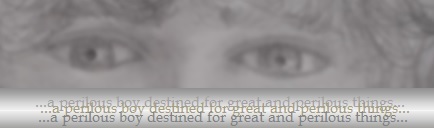
I finally posted Peril’s character page today. I know, it took me long enough, but because his sketch gave me so much trouble, I thought I would do something different with his page and give you a little bit of backstory, which took some crafting. There is always a struggle in just how much to give.
Anyway, let me just say that anyone who has read book one of The Eleventh Age is in for a couple of surprises. And if you haven’t read yet, then what exactly are you waiting for? A signed first edition hard copy? Who knows? Maybe 2015 will be the year.
For once, I have a story about my adventures in sketching characters that doesn’t involve bad art–at least not in the traditional sense.
This is Peril, or Alistair Godfrey, as his parents called him.
It’s been several weeks since I’ve updated the character pages because of Peril, which is strange because from the beginning I believed he would be one of the easier characters to present. Instead he’s proven the most difficult so far. Even worse than Ash, which is saying a lot.
Book one of The Eleventh Age has been completed for some time now, and while I’ve been going through the usual rigamaroo as a new author trying to gain notice in the publishing world, just one more unknown in a sea of countless unknowns, all looking to be discovered, I’ve also been hard at work on book two, which naturally means that in my mind the characters are all different people than who they were at the beginning of their story, or even at end of book one. In building this site, I have had to be very careful not to allow the changes the characters experience through the course of the writing to taint how I present them to the world. This sweet-faced boy was a massive challenge for me in that respect, because he is one of the characters who is most changed from book one to book two, and as I drew him (repeatedly), those changes were visible in his eyes, in the hardness of his lips. I had to put him down, go back and remember who he was before, so that I could show you the Peril Elli meets on her sixteenth birthday.
Heraclitus is quoted by many a philosopher as having pointed out the inevitability of change as a constant, the river’s flow being an apt metaphor for the universal flux we experience not just from day to day but from moment to moment. On this Plutarch writes:
“It is not possible to step twice into the same river according to Heraclitus, or to come into contact twice with a mortal being in the same state.”
This is a beautiful truth that is so easy to miss, as we are only privileged enough to experience the changes within ourselves as we meander through this life. Too often we fail to realize that anything we see of other people, even those we love and hold most dear, is just a small glimpse of who those people are at one bend along their stream. Like a river, every person is always flowing with new waters gained by their own experiences. Each of us is polishing our own boulders into smooth pebbles and cutting our channels deeper as we go.
To live is to change.
Peril will never again be the sweet-faced boy in this picture.
Oftentimes when prophecy plays a role in a story, it is static and unbending in nature. Fate proves to be merely what is fated, a concrete idea of a predetermined purpose, and there is little to be done about it once set in motion, try as one might, and even less to explain why such a purpose is necessary, except that without it there would be no story. An author may employ metaphors or plays on words in order to make prophecies appear to have multiple meanings, so that it is only in the end that one can see the symbolism interwoven throughout the tale all along, hinting at deeper truths, if only the protagonist could have seen. More commonly, stories involve self-fulfilling prophecies, in which belief in a prophecy is required for it to come to fruition, a character’s own attempts to avoid the certain outcome proving to be the very cause. And of course, prophecies are generally vague, leaving plenty of room for doubt, and providing a decent excuse when an interpretation turns out to be completely wrong–just ask Nostradamus.
In The Eleventh Age, things aren’t so simple. Early on in my writing, I began to explore the idea that in order for there to be any sort of prophecy in the first place, Fate actually had to have a purpose in mind, which meant Fate was at least quasi-sentient. This realization marked the birth of Fate as a living, ever-changing character, a character that interacts with the other characters in the story on a continuous basis, rather than being relegated to a stagnant existence as just another fortuneteller spouting pretty prose. But as such, Fate’s role and the nature of prophecy could not just be to provide convenient plot twists that keep the “real” characters on their toes. Fate in The Eleventh Age requires goals, desires, intentions, and otherwise serious character flaws, and trust me when I say that thinking about Fate this way has not been easy.
While Elli Foote, the hero of the story, is told at the beginning of book one that her predestined worst enemy is Roviello Tofal, the evil wizard who has survived more than ten thousand years for the sole purpose of being her arch nemesis, by the end of the book, it is fairly clear that what she has been told and what is reality can be very different things, especially where prophecies are concerned, and she begins to understand that Fate is her enemy as well, a decidedly worse enemy than Roviello Tofal in many ways. This is not to say that Tofal is not particularly evil, or that he will not prove himself to be a spectacular adversary (oh,he is, and he will), but Fate’s role as progenitor of tragedy for Elli throughout the series is certain, as is Elli’s role of seeing Fate as her personal universal foe, even though most people would think the idea of Fate having it out for one person in particular is pretty silly–but what teenager hasn’t thought that the world is out to get them? In this case, she might just happen to be right.
I know it isn’t the most intellectually stimulating entertainment to be had, at least not on the surface, but I have to admit that I actually enjoy the continuous tragedy that is The Walking Dead. Believe it or not, I find the show to be an interesting examination of the nature of evil. As one might expect, the primal cause for all of the characters on the show is avoiding becoming lunch for some dead guy, yet inevitably the greatest source of disaster for the temporary survivors of the slow extinction of the human race is other people just trying to survive. The characters, good and bad, are constantly forced to choose between evils, which leaves the audience with a perpetual knot of repulsion tangled up in awkward commiseration sitting hard in their bellies.
At the end of this Sunday’s Walking Dead, when _____ was ____ in the _____ by that _____ from the _______, my sixteen year old daughter burst into convulsive tears, howling in agony, like ____ was one of her best friends (neurologically speaking, she was a good friend, but this is not another Theory of Mind post). My daughter’s was the titanic sort of meltdown that teenagers are especially prone to when something terrible happens to their favorite character, the kind of meltdown that had her questioning all of humanity and making deals with the universe. She just could not believe ___ was ___, and she wanted someone—anyone— to take it back, to undo “all the feels,” as she muttered through the synthetic fluff of her pillow. For the record, I cried too, but not nearly as hard or as long as she did, though to be fair my own upheaval for ____’s sake was interrupted by a minor internal drama of my own, as I listened to my daughter carrying on about deaths in movies and television shows and books, because as I consoled her I was reminded of my biggest fear as a writer (well, it’s actually my second biggest fear, but my first biggest fear is beside the point… try to stay on point here, people). My (second) biggest fear is that I will fail as an author to make my readers fall apart the way my daughter fell apart Sunday night—completely, and without shame.
As she sobbed over ____ _____, I quietly considered my own duty to provide that visceral explosion within my own audience on a regular basis. It is a duty. No matter the genre of choice, we read to experience a full range of emotions, to live vicariously through the heroes of our imaginations, so a writer who fails to incite chemical riots in the mind and bodies of the masses has no room to call himself a writer. As a writer, I must make certain readers of The Eleventh Age ____ ___ ____ as ____ and ____ ___ ____ ____ by penning small betrayals of their trust along the way. If I want a part of you to ____ when ____ _____, then I must first build every reason for you to believe that can never happen, while at the same time leaving you continuously afraid it will. And in order for you to feel ______ when you figure out that ____ ____ is a _____ and is ___ ____ _____, I have to lie to you and then make you hate me a little when you discover the truth. It is my job to paint those screaming, crying, throw-the-book-across-the-room-in-rage (but a good rage, not a “What the heck do you mean by it was all a dream!!?!” rage) moments that cause your heart to break right in the middle of soaring. I have to make you laugh and cry and fall madly in love and just as madly in hate, and it scares the_____ ____ out of me that I might miss the mark. This fear is irrational, along the lines of worrying obsessively over the potential for losing one’s keys. But the reality is I’m writing to young adults, and every year I get a little, er, less young and more likely to lose my keys.
For the record, my daughter is presently telling me all about the Slated trilogy, by Teri Terry (a good review), which is why this post wound up named “How To Avoid Spoiler Alerts”. The answer is to write MadLib-style blog posts.
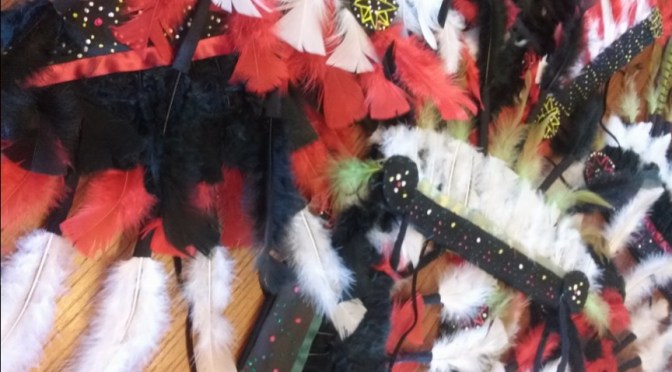
We’re less than a week away from showtime for the local high school musical, and as usual, I’m up to my eyeballs in something or other and loving every minute of it. This year the kids are performing The Music Man, and my older daughter and I will primarily be concerning ourselves with hair–tons of big, Titanic Period hair– along with Native headdresses for the Pick-a-Little Ladies (learn how to make them here), various hats, and the construction of an honest-to-goodness Iowa picnic dress for one young woman, who couldn’t find anything within her budget to wear (and then her engine on her car blew, so my diligent work, which included learning last minute pattern grading, has become charity, which I don’t mind because I have to get into heaven somehow). If everything runs smoothly backstage at dress rehearsal, I may actually get to see my youngest daughter in her all-school production debut as that bit part kid who sings the line “In March I got a grey mackinaw” in The Wells Fargo Wagon on opening night, but I’m not holding my breath, even though I don’t have any beards to glue on this year and no one has to be spontaneously painted green in the last three minutes of each show. There is plenty of big hair to be maintained through costume changes. Needless to say, I’m being kept fairly busy and having great fun in the process.
With all of this happening, this past week I haven’t had any time to write, let alone to think about what I could possibly post on the old blog that would have meaning to potential readers or be relevant to my work. I mean, Sunday rolled around and it was snowing and the house was still covered in feathers. Someone decided it would be great fun to pretend it was Christmas already and created a caroling station on Pandora, so we were dancing and singing, between gluing headdresses together. Monday was a snow day, and the girls went sledding instead of to school, play practice was cancelled, so I made an enormous pot of potato soup (recipe), finished everything but the sleeves and the darts on the dress, and spent the evening doing something I hadn’t done in days–sat still, unbothered, and just relaxed.
Other people’s blogs have been particularly helpful to me this past week, but this morning, faced with a self-imposed every-Tuesday-or-else deadline on my own blog, I thought what the heck is there to write about? I haven’t actually written a single sentence since last Wednesday, and until close of curtain next Tuesday night, I am fairly certain my whole world is going to revolve around that stage and whatever meals can be thrown together in one pot and left to their own devices while I play theater mom. As a rule, this site is meant to be about The Eleventh Age and my journey as an author, so I thought that I would just post a picture of all the feathers and a note that I would be back next Wednesday with something insightful and purposeful to say, but when I sat down at the computer, it occurred to me that there is something so important to write that I am actually going to write it twice:
Sunday rolled around and it was snowing and the house was still covered in feathers.
There is so much joy in that one sentence. I love musical season. I’ll be back next Wednesday.
My husband woke me up early Sunday morning to show me an article about, of all things, clouds. An ordinary girl would be annoyed, being awoken in the wee hours by a man waving a blindingly bright phone in her face, insisting a bit too loudly, “Wake up! You have to read this!” Not me. Believe it or not I am perfectly content squinting though the darkness, trying to make sense of the colorful blurs before my mind has completely stopped dreaming (some of my best eureka moments happen in this state, after all). Of course, my husband usually figures out I can’t exactly see what he’s trying to show me and takes pity, reading the intended passage aloud, before I fall quickly back to sleep, happy–legitimately happy, not just because I get to go back to sleep, although that is nice too, but because the man just gets me.
This is actually a fairly common occurrence in our house, and it isn’t just a middle-of-the-night attempt by my husband to make me suffer his insomnia with him. He often calls during the day just to tell me about some amazing fact he happened across or hurries home after work to show me a picture of some place he thinks will be a great setting for a battle because he totally supports my need to include as much reality in my fantasy as there is fiction in my fantasy. I am grateful for all of the ideas my husband has come up with through the years, even the ideas I won’t ever use, and for the fact that my oftentimes begrudging nature as a writer never seems to get in the way of his enthusiasm, which I have to admit makes him my favorite person in the entire world. I love that he gets just as excited as I do about the prospect of inspiring wonder in people by showing them the magic that exists right here in the real world, no fiction required.
Sunday morning the wonder was fallstreak hole clouds, which apparently received some media attention after residents of Wonthaggi, Australia captured images of the rare occurrence last week. I’m not certain my husband realized that I actually have a fairly extensive file on atmospheric conditions already, which includes what I believed was every description of cloud known to man, until Sunday when my darling Official First Reader woke me up excitedly explaining that elves could in fact make these hole punch clouds when they fly–he had even thought of the fuzzy science to back it up (which made me laugh, in a good way, as I went back to sleep). I don’t know that I will ever write about a fallstreak hole in the way he envisioned them, however he will be happy to know that I have added it to the large list of anomalies witnessed in the Veils of Fate, and while I don’t know exactly what this veil will mean yet, I do know that it will be featured as part of a prophecy seen by Elijah.
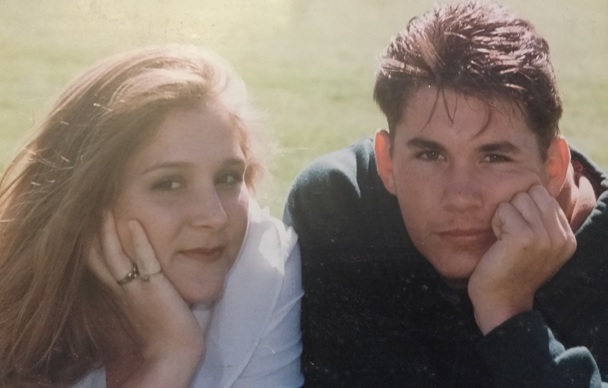
Me and my muse–weren’t we adorable? I don’t know how he’s managed it, but somehow this guy has put up with my nonsense for twenty-one years this week.
The truth is eureka moments, sudden sparks of genius, don’t happen often. Most people don’t have phone-wielding insomniac muses hanging around to be the light bulb that shines over their head on a regular basis, even in their sleep, so they have to work for inspiration. Not that I don’t work for inspiration as well–last week’s post on research hinted at just how much effort goes into finding the small hints of insight that fit within the puzzle I’m building by cutting out random shapes from reality and cobbling them together to make a picture that isn’t completely clear, even to me because my personal journey is about learning.
For the most part, great ideas are born out of this slow building of understanding. It is this slow building that allowed the image of a young Kazakh sayatshy girl to stick with me for months, until one day she became just a small facet of a character who makes her debut in book two of the series. This is how Stavanger, a city in Norway I’ve only visited through the miracle of the internet, became the place where years ago someone important to my characters died, though this man will only ever be mentioned as a ghost that walks through a conversation. Sometimes the slow building lasts for years, as in is the case with the history of fairies in New Zealand. In book two, I incorporate some of the traditional Maori tales into my own. And occasionally the fragile threads of a dozen other ideas come together as an actual spark of genius, to answer questions I’ve had for a very long time and been unable to find the answer just by searching, as is the case with Namcha Barwa, a mountain in Tibet also known as the Breast of Vajrayogini.
A lot of truly great stories, both real and imaginary, have inspired my work. I hope that one day people look back on the stories I write and find inspiration as well.



 The Eleventh Age